Architecture Overview
This page describes the core architecture of the LangDB AI Gateway, a unified platform for interfacing with a wide variety of Large Language Models (LLMs) and building agentic applications with enterprise-grade observability, cost control, and scalability, MCP features and more.
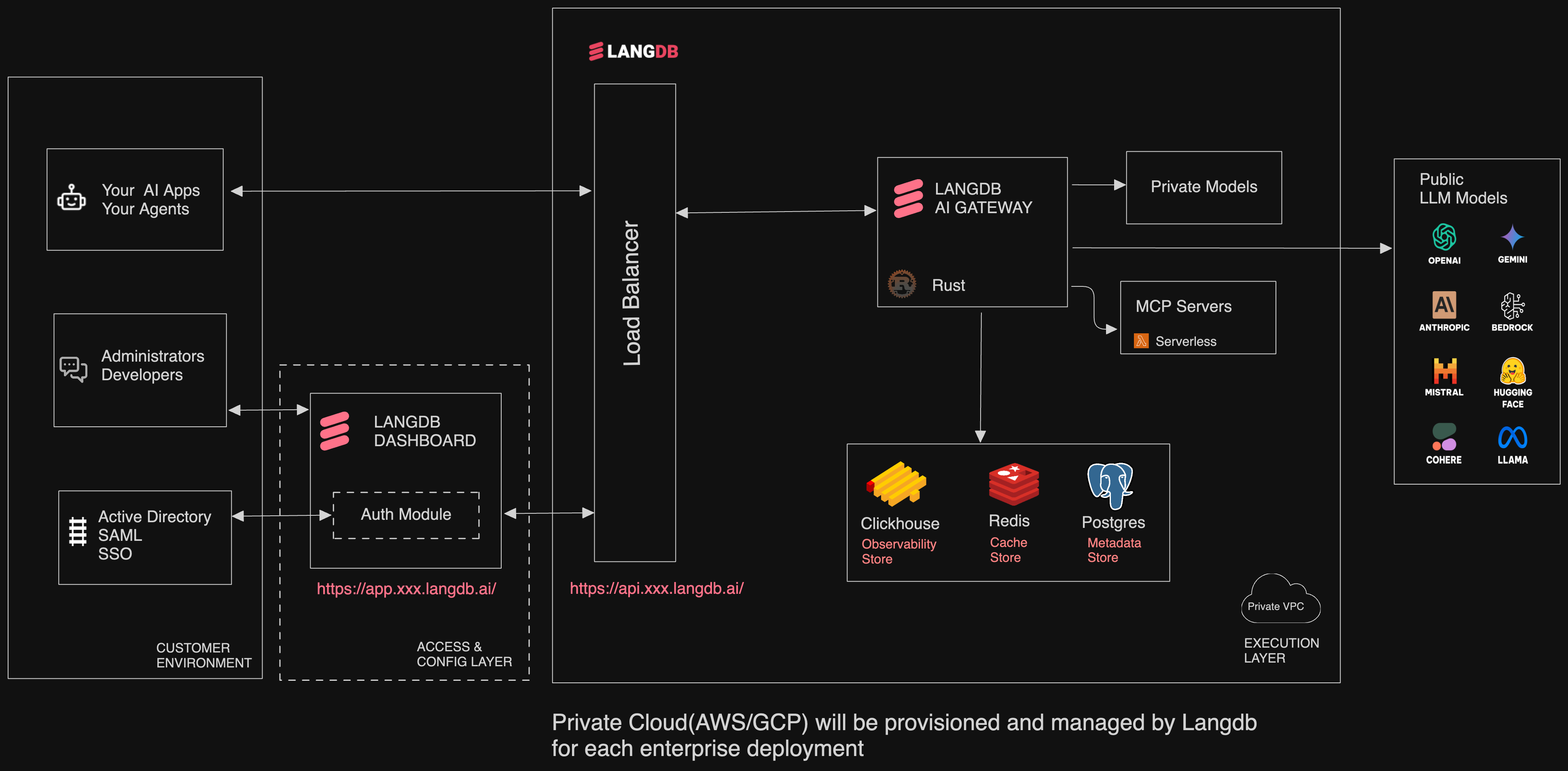
Core Components
| Component | Purpose / Description | Enterprise Features / Notes |
|---|---|---|
| AI Gateway | Unified interface to 300+ LLMs using the OpenAI API format. Built-in observability and tracing. | Multi-tenancy, advanced cost control, and rate limiting. Contact LangDB for access. |
| Metadata Store (PostgreSQL) | Stores metadata related to API usage, configurations, and more. | For scalable/multi-tenant deployments, use managed PostgreSQL (e.g., AWS RDS, GCP Cloud SQL). |
Cache Store (Redis) | Implements rolling cost control and rate limiting for API usage. | Enterprise version supports Redis integration for cost control and rate limiting. |
| Observability & Analytics Store (ClickHouse) | Provides observability by storing and analyzing traces/logs. Supports OpenTelemetry. | For large-scale deployments, use ClickHouse Cloud. Traces stored in langdb.traces table. |
Note:
- Metadata Store: Powered by PostgreSQL (consider AWS RDS, GCP Cloud SQL for enterprise)
- Cache Store: Powered by Redis (enterprise only)
- Observability & Analytics Store: Powered by ClickHouse (consider ClickHouse Cloud for scale)
Environment Overview
LangDB provisions a dedicated environment for each tenant. This environment is isolated per tenant and is set up in a separate AWS account or GCP project, managed by LangDB. Customers connect securely to their provisioned environment from their own VPCs, ensuring strong network isolation and security.
LangDB itself operates a thin, shared public cloud environment (the "control plane") that is primarily responsible for:
- Provisioning new tenant environments
- Managing access control and user/tenant provisioning
- Handling external federated account connections (e.g., SSO)
- Hosting the LangDB Dashboard frontend application for configuration, monitoring, and management
All operational workloads, data storage, and LLM/MCP execution occur within the tenant-specific environment. The shared LangDB cloud is not involved in data processing or LLM execution, but only in provisioning, access management, and dashboard hosting.
Customer Environment
- Integrates with customer identity providers (Active Directory, SAML, SSO).
- Users (AI Apps, Agents, Administrators, Developers) interact with LangDB via secure endpoints.
LangDB Dashboard
- Centralized dashboard for configuration, monitoring, and management.
- Handles user and tenant provisioning, access control, and external federated account connections.
- All provisioning and access is centrally managed via LangDB Cloud and Dashboard.
Tenant Environment (Execution Layer)
- Each tenant (enterprise deployment) is provisioned in a dedicated AWS account or GCP project.
- Communication between tenant environment and LangDB is secured and managed.
- Provisioning is automated via Terraform.
Store Descriptions
Metadata Store (PostgreSQL)
Stores all configuration and metadata required for operation, including:
- Virtual models
- Virtual MCP servers
- Projects
- Guardrails
- Routers
Redis (Cache Store)
Used for fast, in-memory operations related to:
- Rate limiting & cost control
- LLM usage tracking
- MCP usage tracking
ClickHouse (Analytics & Observability Store)
Stores analytics and observability data:
- Traces (API calls, LLM invocations, etc.)
- Metrics (performance, usage, etc.)
User and Tenant Provisioning
- User and tenant provisioning is centrally controlled via LangDB Cloud and Dashboard.
- External federated accounts (e.g., enterprise SSO) can be connected to LangDB Cloud for seamless access management.
Data Retention
- Data retention policies mainly apply to observability data (traces, metrics) stored in ClickHouse.
- Retention is enforced per subscription tier; traces are automatically cleared after the retention period expires.
MCP Server Deployment
- MCP servers are deployed in a serverless fashion using AWS Lambda or GCP Cloudrun for scalability and cost efficiency.