Example: Building an Enterprise Routing Configuration
This example demonstrates a multi-layered routing strategy for a SaaS company that balances performance for premium users, cost for standard users, and flexibility for internal development.
Goals:
- Provide the fastest possible responses for "premium" customers on support-related queries.
- Minimize costs for "standard" tier users.
- Allow the internal "development" team to test a new, experimental model without affecting customers.
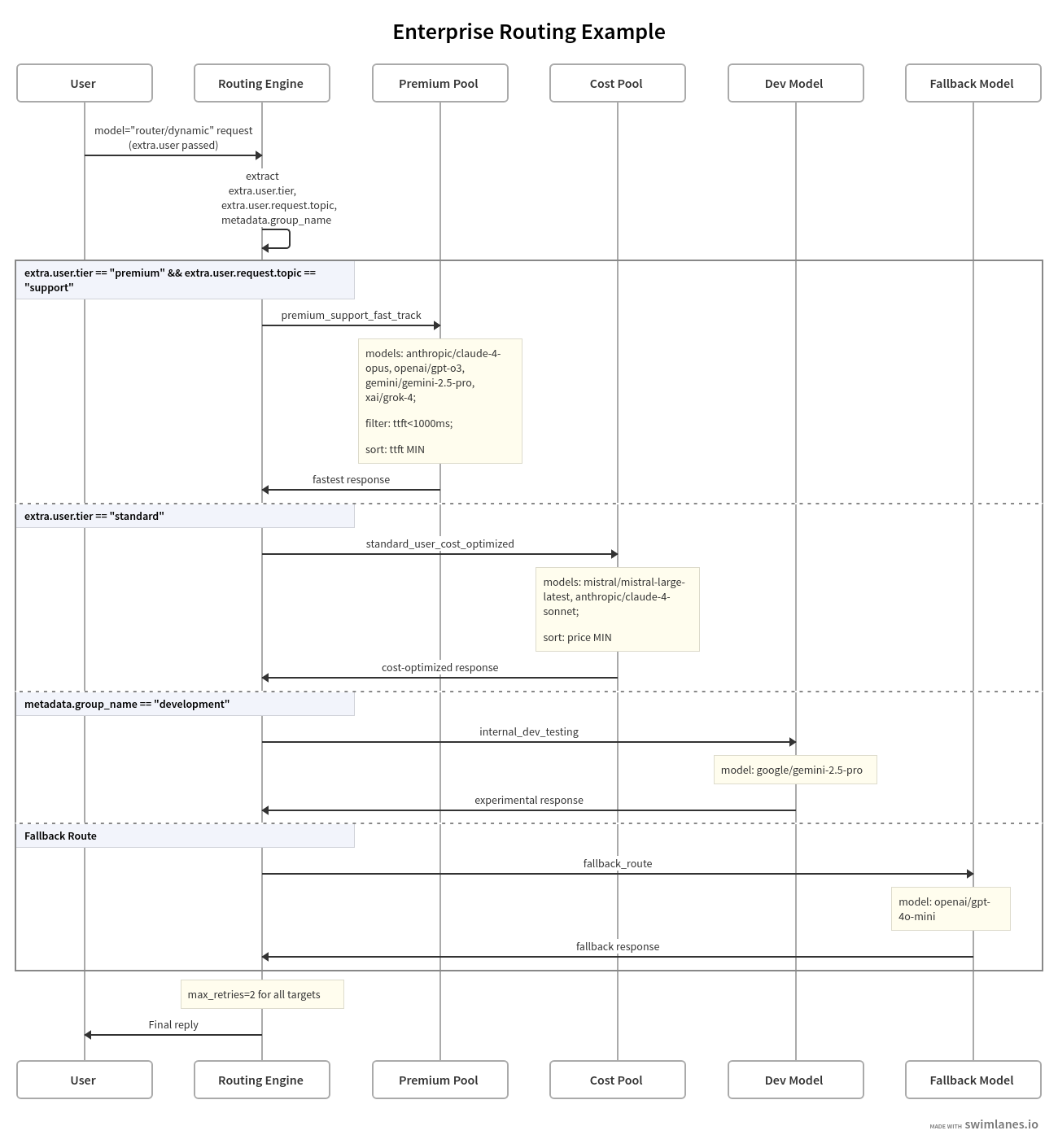
Complete Chat Completion Request with Enterprise Routing:
{
  "model": "router/dynamic",
  "messages": [
    {
      "role": "system",
      "content": "You are an expert customer support agent for TechCorp SaaS platform. You have access to user account information and can help resolve billing, technical, and feature-related issues. Always provide helpful, accurate responses and escalate complex issues when needed."
    },
    {
      "role": "user",
      "content": "Hi, I'm experiencing critical downtime with our enterprise API integration. Our production system has been failing to authenticate for the past 30 minutes and we're losing revenue. This is urgent - can you help me troubleshoot the OAuth token refresh process immediately?"
    }
  ],
  "stream": true,
  "extra": {
    "user": {
      "tier": "premium",
      "request": {
        "topic": "support"
      }
    }
  },
  "router": {
    "type": "conditional",
    "routes": [
      {
        "name": "premium_support_fast_track",
        "conditions": {
          "all": [
            {
              "extra.user.tier": {
                "$eq": "premium"
              }
            },
            {
              "extra.user.request.topic": {
                "$eq": "support"
              }
            }
          ]
        },
        "targets": {
          "$any": [
            "anthropic/claude-4-opus",
            "openai/gpt-o3",
            "gemini/gemini-2.5-pro",
            "xai/grok-4"
          ],
          "filter": {
            "ttft": {
              "$lt": 1000
            }
          },
          "sort_by": "ttft",
          "sort_order": "min"
        }
      },
      {
        "name": "standard_user_cost_optimized",
        "conditions": {
          "extra.user.tier": {
            "$eq": "standard"
          }
        },
        "targets": {
          "$any": [
            "mistral/mistral-large-latest",
            "anthropic/claude-4-sonnet"
          ],
          "sort_by": "price",
          "sort_order": "min"
        }
      },
      {
        "name": "internal_dev_testing",
        "conditions": {
          "metadata.group_name": {
            "$eq": "development"
          }
        },
        "targets": "google/gemini-2.5-pro"
      },
      {
        "name": "fallback_route",
        "conditions": {
          "all": []
        },
        "targets": "openai/gpt-4o-mini"
      }
    ],
    "max_retries": 2
  }
}
Configuration Breakdown:
- Request Structure:
- Uses
"model": "router/dynamic"to enable dynamic routing - User information is passed via the
extra.userobject - Router configuration is specified in the
routerfield with"type": "conditional"
- Uses
- Route 1:
premium_support_fast_track- Conditions: Applies when
extra.user.tierequals"premium"ANDextra.user.request.topicequals"support" - Targets: Routes to high-performance models (
anthropic/claude-4-opus,openai/gpt-o3,gemini/gemini-2.5-pro,xai/grok-4) with filtering for fast response times (ttft < 1000ms) and sorts by minimum time-to-first-token
- Conditions: Applies when
- Route 2:
standard_user_cost_optimized- Conditions: Catches all requests from
"standard"tier users viaextra.user.tier - Targets: Uses cost-effective models (
mistral/mistral-large-latest,anthropic/claude-4-sonnet) and sorts by minimum price
- Conditions: Catches all requests from
- Route 3:
internal_dev_testing- Conditions: Applies to users in the
"development"cost group viametadata.group_name(automatically set by LangDB based on the LangDB user's cost group assignment) - Targets: Routes directly to
google/gemini-2.5-profor isolated testing
- Conditions: Applies to users in the
- Route 4:
fallback_route- Conditions: Empty conditions array (
"all": []) catches all remaining requests - Targets: Routes to
openai/gpt-4o-minias a reliable fallback option
- Conditions: Empty conditions array (
Key Features Demonstrated:
- Conditional Logic: Uses
alloperators and comparison operators ($eq,$lt) - Target Selection: Shows both single targets and pools with filtering/sorting
- Request Context: Leverages both
extrauser data andmetadatafor routing decisions - Cost Group Integration:
metadata.group_nameis automatically populated by LangDB based on the LangDB user's cost group assignment - Retry Configuration: Includes
max_retries: 2for resilience
Additional Example Scenarios
Scenario 1: Standard User Cost-Optimized Request
{
  "model": "router/dynamic",
  "messages": [
    {
      "role": "system",
      "content": "You are a helpful assistant for analyzing business data and generating reports."
    },
    {
      "role": "user",
      "content": "Can you help me create a monthly sales report template with charts for our Q4 review? I need to include revenue trends, customer acquisition metrics, and regional performance comparisons."
    }
  ],
  "extra": {
    "user": {
      "tier": "standard"
    }
  },
  "router": { /* same router config */ }
}
This request will match standard_user_cost_optimized route and use cost-effective models.
Scenario 2: Internal Development Testing
{
  "model": "router/dynamic",
  "messages": [
    {
      "role": "system",
      "content": "You are a code review assistant that helps identify potential bugs and suggests improvements."
    },
    {
      "role": "user",
      "content": "Please review this TypeScript function for potential issues:\n\n```typescript\nfunction processUserData(users: any[]) {\n  return users.map(u => {\n    return {\n      id: u.id,\n      name: u.firstName + ' ' + u.lastName,\n      email: u.email?.toLowerCase()\n    }\n  })\n}\n```"
    }
  ]
  // Note: metadata.group_name = "development" is automatically set by LangDB
  // based on the user's cost group assignment - no need to specify manually
}
This request will match internal_dev_testing route because the LangDB user belongs to the "development" cost group, automatically setting metadata.group_name = "development".
Scenario 3: Fallback Route
{
  "model": "router/dynamic",
  "messages": [
    {
      "role": "user",
      "content": "What's the weather like today?"
    }
  ],
  "extra": {
    "user": {
      "tier": "basic"
    }
  },
  "router": { /* same router config */ }
}
This request doesn't match any specific conditions and will use the fallback_route with GPT-4o-mini.